
DYMAX 6-621-VT
Harmonization Code : 3824.99.92.97 | Prepared binders for foundry molds or cores; chemical products and preparations of the chemical or allied industries (including those consisting of mixtures of natural products), not elsewhere specified or included: other : other : other
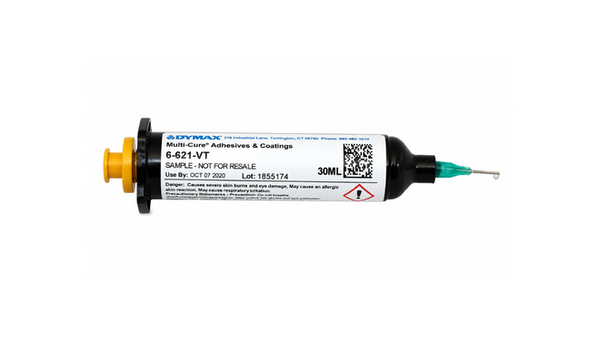
Main features
- High-Viscosity Bead Retention
- Multi-Cure Joint Accessibility
- Structural Battery Bonding Fit
Product Description
Dymax Multi-Cure 6-621-VT Adhesive is the high-viscosity member of the 6-621 structural adhesive family. The thicker flow profile supports applications that need improved bead retention or reduced movement after dispensing, while UV and visible light provide the primary cure route on exposed material. Secondary heat and compatible activator cure extend processing into shadowed bond areas. The adhesive is used for bonding phenolic and filled plastics, glass, and metals, with applications including metal-to-glass assembly, coil winding, potting, and structural battery bonding. Its main selection distinction is higher pre-cure viscosity within a shared multi-cure platform.
Key features
- High-viscosity bead retention: The VT grade is selected where a thicker, more stationary adhesive profile is useful.
- Multi-Cure process coverage: UV/visible, heat, and activator routes address exposed and shadowed regions.
- Structural family compatibility: The documented scope includes phenolic materials, glass, metals, and battery assemblies.
Applications / Suitable for
- Metal-to-glass bonding
- Coil winding and potting
- Structural battery bonding
TDS, SDS & Technical Documents
Technical Specifications
General Properties
Thermal Properties
Chemical Properties
Additional Information
As-supplied / before-processing properties
As-supplied characteristics for the high-viscosity 6-621 family variant.
| Property | Value | Unit | Method / condition |
|---|---|---|---|
| Viscosity class | High | As supplied | |
| Placement behavior | Thick, bead-retaining profile | Before cure | |
| Primary cure activation | UV and visible light | Exposed adhesive areas | |
| Secondary cure option | Heat | Areas with limited light access | |
| Activator cure option | Compatible activator | Close-fitting or shadowed joints |
After-processing / final-state properties
Cured-state function and Bonded-material scope.
| Property | Value | Unit | Method / condition |
|---|---|---|---|
| Final function | Structural bonded joint | After complete cure | |
| Bonded material scope | Phenolic and filled plastics; glass; metal | Substrate range | |
| Bondline character | Retained localized bondline | After curing the high-viscosity placement | |
| Assembly roles | Coil winding; potting | Within the Application scope | |
| Battery assembly role | Structural battery bonding | Within the Application scope |


