
LAIRD TPUTTY 403
Harmonization Code : 8473.30.80.00 | Parts and accessories (other than covers, carrying cases and the like) suitable for use solely or principally with machines of headings 8470 to 8472 ; Parts and accessories of the machines of heading 8471 ; Other; Other
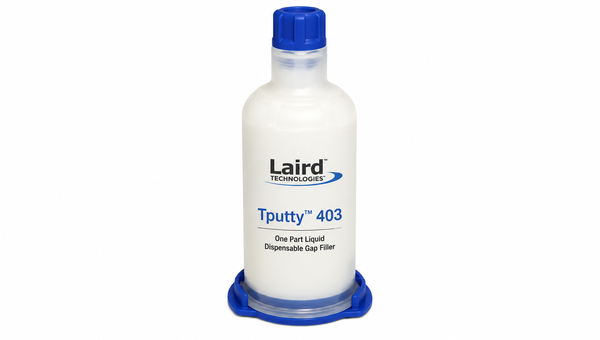
Main features
- 2.3 W/(m K) One-Part Putty
- 0.05 mm Minimum Bondline
- ASTM E595 0.05% TML/0.02% CVCM
Product Description
Tputty™ 403 One Part Liquid Dispensable Gap Filler is a white, single-part, silicone-based thermal interface material for large or uneven gaps. It is supplied ready to dispense and does not require mixing or chemical cure. The soft, compliant, low-abrasion material is designed to transfer little to no pressure to mating components while providing a typical 2.3 W/m·K thermal conductivity. Published interface and material data include a 0.05 mm minimum bondline thickness, 2.48–2.50 g/cm³ density, -45°C to 150°C operating range, 0.05% TML, 0.02% CVCM, and UL 94 V-0 flammability classification.
Key features
- One-part, ready-to-dispense silicone putty with no mixing or cure step
- Soft and compliant for large or uneven gap tolerances
- Typical 2.3 W/m·K thermal conductivity
- Low-abrasion formulation for dispensing equipment and mating surfaces
- Minimum bondline thickness of 0.05 mm under the supplier test method
- ASTM E595 outgassing values of 0.05% TML and 0.02% CVCM
- Available in cartridges and bulk pails for manual or automated dispensing
Applications
- Automotive electronics
- Servers, wireless infrastructure, and telecom/datacom equipment
- Gaming systems, notebooks, tablets, and portable devices
- Smart-home devices, drones, and satellite-related assemblies
TDS, SDS & Technical Documents
Technical Specifications
General Properties
Thermal Properties
Electrical Properties
Additional Information
Tputty™ 403 One Part Liquid Dispensable Gap Filler
A white, silicone-based, non-curing thermal putty for filling large or uneven interfaces. It is supplied ready to dispense and is designed to remain soft and compliant, limiting mechanical pressure on mating parts while creating a thermal path between heat-generating components and heat-transfer structures.
.png)
Ready-to-use white silicone putty
The product is supplied as a single-part paste. Under normal storage conditions, the application note states that mixing or warming is not required before use.
| Property | Typical value | Context |
|---|---|---|
| Construction | Single-part silicone-based dispensable gap filler | Non-curing thermal putty. |
| Colour | White | Visual. |
| Density | 2.48 g/cm³ in the 2018 datasheet; 2.50 g/cm³ on the current product page and SDS | Helium pycnometer for the datasheet value. |
| Flow rate | 29 g/min | 75 cc tapered tip, 0.125 in orifice, 40 psi; Laird method A16724-00. |
| Shelf life | 2 years from date of shipment | Current product-page value. |
Dispense directly into the interface and control the final gap
- Use the product directly from the container; no component mixing or cure step is required.
- Ensure mating surfaces are clean and dry before dispensing.
- Validate nozzle, pressure, speed, stand-off, deposit volume, and material temperature on the production equipment.
- Material dispensed below 23°C may flow more slowly than the datasheet condition.
- Control the installed gap and avoid excessive squeeze-out or unsupported migration.
- Remove excess material with a dry rag; residual silicone oil may require a validated compatible cleaning process.
- Avoid exposure to organic solvents or strong bases because swelling or carrier removal may reduce performance.
.png)
Storage and industrial handling
Store in the original product packaging until use and follow the current package label. The current US SDS, Version 2.1, was issued 13 February 2025 and identifies the product for industrial use only. It is not classified as hazardous under OSHA Hazard Communication Standard 2012, but handling must still follow the SDS, including ventilation, personal protection, spill control, dust-control precautions where relevant, and environmental-release prevention.
Bulk thermal data, tested bondline, electrical properties, and outgassing
Thermal conductivity is a bulk property. Installed resistance also depends on final gap, contact area, surface condition, interface count, pressure, voids, migration, and assembly geometry.
| Property | Typical value | Test context |
|---|---|---|
| Thermal conductivity | 2.3 W/m·K | Hot Disk. |
| Minimum bondline thickness | 0.05 mm (50 µm) | Laird method A16112-00; not a universal recommended gap. |
| Operating-temperature range | -45°C to 150°C | Laird test method; assembly qualification required. |
| Outgassing TML | 0.05% | ASTM E595. |
| Outgassing CVCM | 0.02% | ASTM E595. |
| Dielectric breakdown | >6000 VAC | ASTM D149; specimen thickness is not stated in the datasheet. |
| Dielectric constant | 4.9 at 1 MHz | ASTM D150. |
| Volume resistivity | 1 × 10¹³ ohm-cm | ASTM D257. |
| Flammability | UL 94 V-0 | Formulation- and test-construction-specific classification. |
Stable measured temperature difference under three ageing conditions
The supplier reliability report tested 45 mil specimens in aluminium heater and cooler fixtures. Six positions were averaged for each condition. The reported delta-T remained stable during 150°C isothermal bake, thermal shock between -40°C and 125°C with 30-minute dwells and transitions under 20 seconds, and 85°C/85% RH ageing. The report concludes that no thermal degradation was evidenced under conditions similar to those tested.
150°C fixture exposure; preserve the report duration and fixture configuration when comparing.
-40°C to 125°C, 30-minute dwells, transition typically under 20 seconds, reported to 1000 cycles.
85°C/85% RH, reported to 1000 hours in the plotted results.
Fill irregular thermal gaps with minimal mating-part pressure
The current product page lists automotive electronics, drones and satellites, gaming systems, notebooks, tablets, portable devices, servers, smart-home devices, and wireless infrastructure. Final qualification should establish the actual gap range, dispensed volume, assembly pressure, squeeze-out, vertical or inverted stability, vibration response, thermal resistance, outgassing suitability, electrical clearances, rework method, and long-term migration behaviour.
Tputty 403 Thermal Reliability Report
This supplier report documents the fixture, ageing conditions, specimen thickness, test population, and plotted delta-T results used for the reliability summary above.
Validate Tputty™ 403 for your dispensable thermal interface
Krayden can help review gap range, dispense package, nozzle, pressure, temperature, deposit volume, bondline control, squeeze-out, migration, installed thermal resistance, outgassing requirements, cleaning, rework, vibration, and assembly qualification.


