
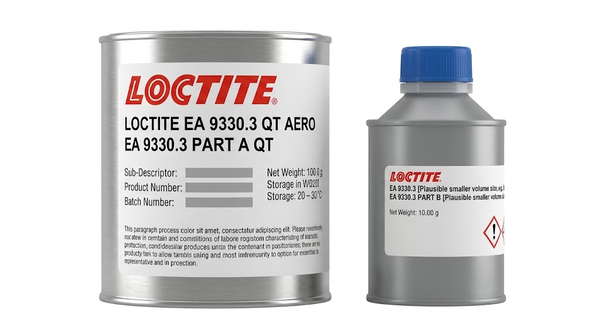
LOCTITE EA 9330.3
Harmonization Code : 3506.91.90.99 | Prepared glues and other prepared adhesives, not elsewhere specified or included; products suitable for use as glues or adhesives, put up for retail sale as glues or adhesives, not exceeding a net weight of 1 kg ; Adhesives based on polymers of headings 3901 to 3913 or on rubber; Other ; Other
Main features
- Thixotropic Application Control
- 1-Hour 82 deg C Cure
- 33.8 MPa Aluminum Lap Shear
Product Description
LOCTITE EA 9330.3 AERO is a two-component, room-temperature-curing epoxy paste adhesive formulated with thixotropic, low-slump handling and high peel strength. The 100:33 Part A-to-Part B weight mix provides a 60-minute pot life for a 100 g mass at 25°C. The mixed adhesive is gray with a density of 1.14 g/mL. It reaches handling strength after 24 hours at temperatures above 25°C and develops normal performance after 5–7 days, with an alternative 1-hour cure at 82°C for small masses. Typical testing on phosphoric-acid-anodized 2024-T3 AlClad aluminum demonstrates tensile lap shear and peel performance across subzero, ambient, and elevated temperatures.
Key features
- Low-slump thixotropic paste: Supports controlled placement before cure without converting the rheology description into a drip- or void-prevention claim.
- Defined mix and working window: Mix Part A and Part B at 100:33 by weight; typical pot life is 60 minutes at 25°C for a 100 g mass.
- Room-temperature or accelerated cure: Normal performance develops after 5–7 days above 25°C; a 1-hour cure at 82°C may be used for small mixed masses.
- Prepared-aluminum lap shear performance: Typical tensile lap shear is 33.8 MPa at 25°C after a 5-day room-temperature cure on phosphoric-acid-anodized 2024-T3 AlClad aluminum.
- Peel performance: Typical floating roller peel is 414 N/25 mm at 25°C after a 5-day room-temperature cure under the stated test conditions.
TDS, SDS & Technical Documents
Technical Specifications
General Properties
Physical Properties
Additional Information
LOCTITE EA 9330.3 AERO
LOCTITE EA 9330.3 AERO is a two-component, thixotropic epoxy paste adhesive developed for low-slump application and high peel strength. It mixes at 100:33 by weight, provides a 60-minute pot life at 25°C for a 100 g mass, and supports room-temperature cure or an accelerated 1-hour cure at 82°C for small mixed quantities.

LOCTITE EA 9330.3 AERO
As-Supplied Properties
| Property | Value | Unit / state | Method / condition |
|---|---|---|---|
| Color | Gray / clear / gray | Part A / Part B / mixed | As supplied and immediately after complete mixing |
| Part A viscosity | 120–550 | Pa·s | 25°C; Brookfield HBT, spindle 7 at 2.1 rad/s |
| Part B viscosity | 22.0–48.4 | Pa·s | 25°C; Brookfield HBT, spindle 5 at 2.1 rad/s |
| Part A density | 1.17 | g/mL | As supplied |
| Part B density | 1.06 | g/mL | As supplied |
| Mixed density | 1.14 | g/mL | After mixing at the specified ratio |
| Part A warranty life | 1 | year | Stored below 25°C |
| Part B warranty life | 1 | year | Stored below 25°C |
Processing and Cure
Bring the separate components close to room temperature, then combine and mix completely at the specified weight ratio. Do not mix quantities greater than 250 g because heat buildup can cause uncontrolled decomposition and toxic fumes. Apply the adhesive to clean, dry, properly prepared bonding surfaces and hold the parts in contact until set. Remove uncured excess before it hardens; denatured alcohol and many common industrial solvents may be suitable when used in accordance with the solvent supplier’s safety instructions.
Keep each component tightly closed in a cool, well-ventilated area away from incompatible materials. Warranty life is 1 year for both Part A and Part B when stored below 25°C. Do not heat Part B above 100°C. Use adequate ventilation, avoid skin and eye contact, and follow current product labeling and safety documentation before use.
Cured Properties
Typical bulk-resin properties under the stated specimen, temperature, frequency, and test-method conditions.
| Property | Typical value | Unit | Method / condition |
|---|---|---|---|
| Tensile strength | 42.0 | MPa | 25°C; ASTM D638 using 3.18 mm castings |
| Tensile modulus | 2687 | MPa | 25°C; ASTM D638 using 3.18 mm castings |
| Elongation at break | 9 | % | 25°C; ASTM D638 using 3.18 mm castings |
| Shore D hardness | 81 | Shore D | 25°C |
| Glass transition temperature | 54 | °C | DMTA |
| Cured density | 1.11 | g/cm³ | ASTM D1622 |
| Dielectric constant | 4.46 | — | 1 kHz and 25°C; ASTM D150 |
| Dissipation factor | 0.013 | — | 1 kHz and 25°C; ASTM D150 |
Performance Evidence
The following typical results preserve the tested substrate, surface preparation, cure, bondline, method, and temperature conditions needed for technical interpretation.
| Test temperature | Typical strength (MPa) | Typical strength (psi) |
|---|---|---|
| −55°C | 39.3 | 5,700 |
| 25°C | 33.8 | 4,900 |
| 71°C | 11.7 | 1,700 |
| 82°C | 7.6 | 1,100 |
| Bondline thickness | Typical strength (MPa) | Typical strength (psi) |
|---|---|---|
| 0.08 mm | 35.8 | 5,200 |
| 0.13 mm | 34.5 | 5,000 |
| 0.25 mm | 33.1 | 4,800 |
| 1.27 mm | 28.9 | 4,200 |
| 1.91 mm | 26.2 | 3,800 |
| Post-cure duration | Tested at 25°C (MPa) | Tested at 71°C (MPa) |
|---|---|---|
| 3 days | 37.2 | 15.8 |
| 7 days | 41.3 | 14.5 |
| 15 days | 42.0 | 15.2 |
| 30 days | 42.7 | 16.5 |
| 60 days | 41.3 | 14.5 |
| Bondline thickness | Typical T-peel (N/25 mm) | Typical T-peel (lb/in) |
|---|---|---|
| 0.08 mm | 223 | 50 |
| 0.13 mm | 223 | 50 |
| 0.25 mm | 245 | 55 |
| 0.50 mm | 267 | 60 |
| 0.76 mm | 258 | 58 |
| T-peel rate | Typical T-peel |
|---|---|
| 51 mm/min | 200 N/25 mm |
| 127 mm/min | 200 N/25 mm |
| 254 mm/min | 200 N/25 mm |
| 305 mm/min | 200 N/25 mm |
| 762 mm/min | 200 N/25 mm |
| Floating-roller test temperature | Typical peel (N/25 mm) | Typical peel (lb/in) |
|---|---|---|
| −55°C | 129 | 29 |
| 25°C | 414 | 93 |
| 70°C | 53 | 12 |
Technical Support
Contact Krayden to discuss mix control, surface preparation, bondline selection, cure scheduling, and the relevance of the typical lap-shear and peel data to your specific substrates, joint geometry, production process, and operating temperatures.


