
LOCTITE EA 9394.3
Harmonization Code : 3506.91.90.99 | Prepared glues and other prepared adhesives, not elsewhere specified or included; products suitable for use as glues or adhesives, put up for retail sale as glues or adhesives, not exceeding a net weight of 1 kg ; Adhesives based on polymers of headings 3901 to 3913 or on rubber; Other ; Other
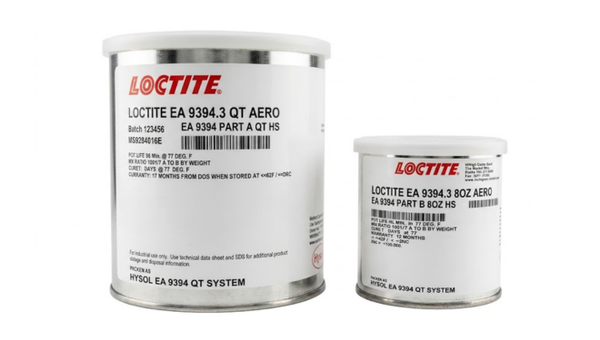
Main features
- 4,200 psi Aluminum Lap Shear
- 90-Minute Working Window
- Thixotropic Gap-Filling Control
Product Description
LOCTITE EA 9394.3 AERO is a two-part structural epoxy paste adhesive that cures at room temperature and is formulated for bonded assemblies requiring controlled bondline thickness and elevated-temperature performance. Its thixotropic, gap-filling consistency supports structural bonding, potting, filling and liquid-shim work, while 5 mil glass beads help control the bondline. The mixed adhesive has a typical 90-minute pot life at 25°C for a 450 g mass. Typical ASTM D1002 lap-shear testing on phosphoric-acid-anodized 2024-T3 aluminum shows 4,200 psi at 25°C and 1,200 psi at 177°C.
Key features
- Elevated-temperature lap shear: Typical tensile lap shear is 1,200 psi (8.3 MPa) at 177°C under the stated aluminum test configuration.
- Controlled bondline: The formulation contains 5 mil glass beads to help establish bondline thickness.
- Extended pot life: Typical pot life is 90 minutes at 25°C for a 450 g mixed mass.
- Room-temperature or accelerated cure: Cure for 3–5 days at 25°C, or use 1 hour at 66°C for complete cure; accelerated cure is limited to small masses.
- Thixotropic gap filling: The paste consistency supports potting, filling and liquid-shim applications.
Applications / Suitable for
- Structural bonding of properly prepared aluminum assemblies
- Potting and cavity filling
- Liquid shimming and controlled-gap bonding
TDS, SDS & Technical Documents
Technical Specifications
General Properties
Physical Properties
Additional Information
LOCTITE EA 9394.3 AERO
LOCTITE EA 9394.3 AERO is a two-part, room-temperature-curing structural epoxy paste for assemblies that require controlled bondline thickness, gap filling and retained strength at elevated temperature. The thixotropic mixed adhesive contains 5 mil glass beads and provides a typical 90-minute pot life at 25°C for a 450 g mass.
Uncured properties
Typical component and mixed-material values. Viscosity data are method- and temperature-specific and should not be compared without preserving the stated Brookfield conditions.
| Property | Value | Unit | Method / condition |
|---|---|---|---|
| Color | Part A: gray; Part B: black; mixed: gray | — | As supplied and immediately after mixing |
| Viscosity at 25°C | Part A: 400–800; Part B: 20–70; mixed: 160 | Pa·s | Brookfield HBT; Part A spindle 7, Part B spindle 4 and mixed spindle 5 at 2.09 rad/s |
| Density | Part A: 1.50; Part B: 1.00; mixed: 1.36 | g/mL | Typical as-supplied values |
| Shelf life | 1 year for Part A and Part B | — | Stored below 25°C |
| Bondline-control beads | 5 | mil | Glass beads contained in the mixed adhesive |
| Physical form and rheology | Thixotropic paste | — | Two-component structural epoxy adhesive |
Mixing, application and cure
Process control is important for ratio accuracy, mixed-mass temperature, bondline formation and cure development. Keep working-time, handling-strength and full-cure stages distinct when planning assembly loads.
Store Part A and Part B below 25°C; the stated shelf life is 1 year for each component. Keep containers tightly closed in a cool, well-ventilated location away from incompatible materials. Components should be near 25°C before mixing. Use appropriate ventilation and protective equipment, and do not heat unmixed Part A above 80°C or Part B above 100°C.
Cured material properties
Typical bulk-resin properties. These values describe cured material specimens and should not be treated as guaranteed bonded-joint design allowables.
| Property | Value | Unit | Method / condition |
|---|---|---|---|
| Tensile strength | 6,675 | psi (46.04 MPa) | Typical at 25°C; ASTM D638 using 3.18 mm castings |
| Tensile modulus | 0.615 × 10⁶ | psi (4,242 MPa) | Typical at 25°C; ASTM D638 using 3.18 mm castings |
| Shear modulus, dry | 212,000 | psi (1,462 MPa) | Typical at 25°C |
| Shear modulus, wet | 148,500 | psi (1,204 MPa) | Typical at 25°C |
| Elongation at break | 1.66 | % | Typical at 25°C |
| Shore D hardness | 88 | — | Typical at 25°C |
| Glass transition temperature, dry | 78 | °C | Typical bulk-resin value |
| Glass transition temperature, wet | 68 | °C | Typical bulk-resin value |
Typical lap shear strength by test temperature
ASTM D1002 results after a 5-day cure at 25°C on phosphoric-acid-anodized 2024-T3 bare aluminum. Values are typical laboratory results for the stated specimen configuration.
| Property | Value | Unit | Method / condition |
|---|---|---|---|
| Tensile lap shear at −55°C | 3,300 | psi (22.8 MPa) | ASTM D1002; 2024-T3 bare aluminum, phosphoric-acid anodized per ASTM D3933; 5-day cure at 25°C |
| Tensile lap shear at 25°C | 4,200 | psi (29.0 MPa) | Same specimen preparation and cure |
| Tensile lap shear at 82°C | 3,000 | psi (20.7 MPa) | Same specimen preparation and cure |
| Tensile lap shear at 93°C | 2,900 | psi (20.0 MPa) | Same specimen preparation and cure |
| Tensile lap shear at 121°C | 2,300 | psi (15.9 MPa) | Same specimen preparation and cure |
| Tensile lap shear at 149°C | 1,600 | psi (11.0 MPa) | Same specimen preparation and cure |
| Tensile lap shear at 177°C | 1,200 | psi (8.3 MPa) | Same specimen preparation and cure |
| Tensile lap shear at 204°C | 600 | psi (4.1 MPa) | Same specimen preparation and cure |
Environmental exposure and peel performance
The following results provide additional context for tensile lap shear after liquid exposure and for bell peel on prepared aluminum. They apply only to the stated specimens, conditioning and test methods.
Applications
The product combines structural bonding performance, thixotropic gap filling and built-in bondline control for several prepared-assembly use contexts.


Evaluate LOCTITE EA 9394.3 AERO for your assembly
Krayden can help review mix-ratio control, batch size, cure selection, bondline requirements and the relevance of the aluminum lap-shear data to your assembly. Contact our team to discuss product selection, samples, processing questions or a qualification plan for your specific substrates and operating conditions.


