
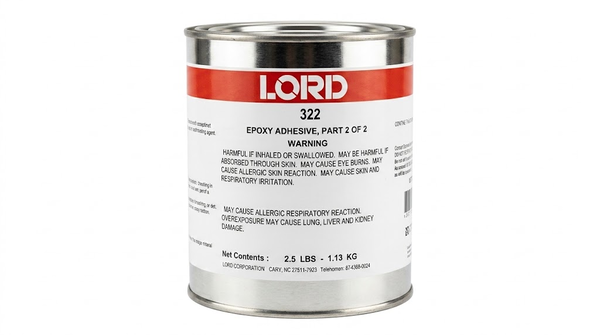
LORD 322
Harmonization Code : 8529.90 | Parts solely or principally used for TV, radio, and transmission
Main features
- General-Purpose Two-Component Epoxy for SMC
- 20 to 40-Minute Working Window
- 30.6 MPa Cured Tensile Strength
Product Description
LORD® 322 Hardener Epoxy Adhesive is a general-purpose, two-component structural adhesive system comprising LORD 320 resin and LORD 322 hardener. It is formulated for primerless bonding to automotive sheet moulding compound (SMC) and also supports prepared metals, rubber, fibre-reinforced plastics, polyester thermosets, thermoplastics, glass, ceramics, and other validated substrates. The mixed adhesive is a grey, 100% solids paste with a typical 20–40 minute working time at 24°C and 2–4 hour handling-strength time. It can reach full strength in approximately 24 hours at 18°C or above, or in 45–60 minutes at 82°C.
Key features
- Multi-substrate structural bonding: formulated for SMC and suitable for evaluation on prepared metals, rubber, FRP, thermosets, thermoplastics, glass, and ceramics.
- Room-temperature or accelerated cure: approximately 24 hours at 18°C or above, with 45–60 minute full-cure strength development at 82°C.
- Durable cured epoxy: 30.6 MPa tensile strength, 80°C glass-transition temperature, and documented resistance to humidity, salt spray, temperature extremes, and post-bakes.
Applications
- Automotive SMC and composite assembly
- Prepared-metal and mixed-material structural joints
- Rubber-to-metal and composite bonding after the specified surface treatment
- US solar-panel roof-mounting brackets under the supplier's regional application guidance
TDS, SDS & Technical Documents
Technical Specifications
General Properties
Physical Properties
Thermal Properties
Additional Information
LORD® 320/322 Epoxy Adhesive
A general-purpose epoxy system comprising off-white LORD 320 resin and grey LORD 322 hardener. It is formulated for primerless adhesion to automotive SMC and supports structural bonding of prepared metals, rubber, fibre-reinforced plastics, polyester thermosets, thermoplastics, and other qualified materials.
.png)
High-viscosity pastes with application-specific mix ratios
The standard general-purpose ratio is 1:1 by volume or 1.2:1 by weight. Alternative ratios are published for specific joint-stress and temperature profiles and must not be selected without validating the intended design.
| Property | LORD 320 resin | LORD 322 hardener | Mixed adhesive |
|---|---|---|---|
| Appearance | Off-white paste | Grey paste | Grey paste; grey after cure |
| Viscosity at 25°C | 300,000–1,000,000 cP, Brookfield HBF Helipath, 5 rpm, T-bar D | 450,000–2,000,000 cP, Brookfield HBF Helipath, 5 rpm, T-bar E | Not published as a single mixed-viscosity value |
| Density | 1498–1546 kg/m³ | 1238–1263 kg/m³ | Use component and mix-ratio data for material calculations |
| Flash point | >93°C, closed cup | >93°C, closed cup | Refer to the current component SDS documents |
| General-purpose mix ratio | 1:1 by volume or 1.2:1 resin-to-hardener by weight | ||
| High-temperature shear-joint ratio | 1.5:1 by volume or 1.8:1 by weight | ||
| Low-temperature peel-joint ratio | 1:1.5 by volume or 1:1.2 by weight | ||
| Solids content | 100% | ||
| Working and handling time | 20–40 minutes working time at 24°C for a 54 g mass; 2–4 hours to handling strength | ||
Prepare clean surfaces, mix uniformly, and maintain a controlled bondline
- Remove grease, oil, fingerprints, dust, mould-release agents, rust, and other contaminants.
- Use an isopropyl-alcohol wipe on oxidation-free metals; abrade oxidation or mill scale where required and clean again.
- Use LORD 7701 surface treatment for cured rubber and LORD AP-134 for glass or ceramic when required by the TDS.
- Mix resin and hardener until the colour and consistency are uniform without whipping excessive air into the material.
- Limit batch size because exothermic heat buildup shortens working time; do not use adhesive that has begun to cure.
- Apply by automatic meter/mix/dispense equipment, cartridge, stiff brush, spatula, trowel, or disposable cone.
- Use approximately 0.51–0.76 mm film thickness for general applications; validate glass beads when tighter bondline control is needed.
- Mate parts to avoid entrapped air and use only enough pressure to achieve complete wetting without starving the joint.
.png)
Hold the joint stable until handling strength and control heat-cure temperature
Approximately 24 hours to full strength when the adhesive, substrates, and ambient temperature are at least 18°C.
45–60 minutes at 82°C. The bondline temperature must not exceed 162°C during cure.
Clamp only when movement is likely. Use uniform pressure and avoid excessive clamping that squeezes adhesive out of the joint.
Clean uncured excess before cure. Fully cured adhesive can be softened at approximately 204°C or above for part separation; validate heat exposure against the substrates.
Storage and industrial safety
Shelf life is two years from date of manufacture when LORD 320 resin and LORD 322 hardener are stored at 16–27°C in their original unopened containers. The TDS restricts the product to industrial or commercial use by trained personnel. Review the current regional SDS for each component and the container labels before handling, mixing, application, cleanup, storage, transport, or disposal.
High-strength cured epoxy with substrate-specific joint data
The following values are typical and not specification limits. Joint strength depends on substrate, preparation, bondline, mix ratio, cure, specimen geometry, test temperature, and failure mode.
| Property or joint | Typical result | Test context |
|---|---|---|
| Tensile strength at break | 30.6 MPa | Modified ASTM D882-83A. |
| Elongation | 3% | Modified ASTM D882-83A. |
| Young’s modulus | 1586 MPa | Modified ASTM D882-83A. |
| Glass-transition temperature | 80°C | ASTM E1640-99 by DMA. |
| Cold-rolled steel lap shear at room temperature | 15.3 MPa | MEK wipe, grit blast, MEK wipe; 0.254 mm film; 72 h room-temperature cure; 1:1 by volume. |
| Aluminium lap shear at room temperature | 11.7 MPa | Same metal-joint preparation and cure basis. |
| SMC-to-SMC lap shear at room temperature | 4.3 MPa | 320-grit sanding and dry-rag wipe; 0.762 mm film; 72 h room-temperature cure. |
| Natural rubber-to-steel 45° peel | 11.0 N/mm | Rubber treated with LORD 7701; 0.508 mm film; 72 h room-temperature cure. |
| SBR-to-SBR T-peel | 15.9 N/mm | SBR treated with LORD 7701; 0.508 mm film; 72 h room-temperature cure. |
Design joints to carry shear, tensile, or compressive loads while minimising peel and cleavage
The supplier structural-bonding guide recommends distributing load across the bonded area and avoiding geometries that concentrate peel or cleavage. Lap joints are generally preferred for thin materials. Place a continuous bead so that mating does not trap air, slide rather than separate parts during minor repositioning, and hold the assembly with even pressure until handling strength develops.
Directly formulated for automotive SMC and supported for FRP, polyester thermosets, and selected thermoplastics after validation.
Supports prepared metal, rubber, glass, ceramic, and composite combinations using the documented surface treatment.
The regional brochure positions LORD 320/322 for bonded roof-mounting brackets. Treat the application, installation sequence, certifications, and warranty implications as US-specific.
Structural bonding and solar-mounting guidance
Structural Adhesive Bonding Application Guide
Joint-design, surface-preparation, cartridge-purging, bead-sizing, fixturing, failure-mode, and rework guidance applicable to LORD structural adhesives.
Open AG1018Structural Adhesives for Solar Panel Roof Mounting
US-only brochure covering LORD 320/322 positioning, installation steps, selected regulatory statements, and IIT testing categories for bonded solar mounting.
Open PB8392Validate LORD® 320/322 for your structural-bonding process
Krayden can help review substrate preparation, resin-to-hardener ratio, cartridge or bulk dispensing, batch exotherm, bead sizing, bondline control, joint geometry, fixturing, room-temperature or heat cure, failure mode, environmental exposure, and application-specific qualification.


