
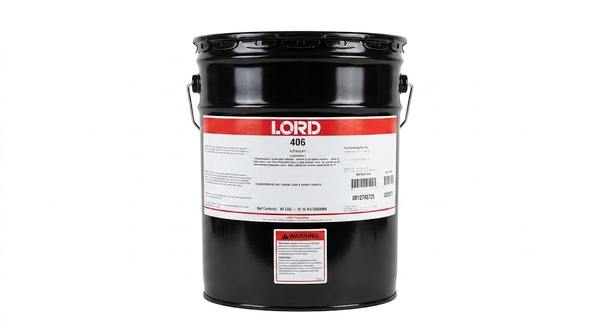
LORD 406
Harmonization Code : 8529.90 | Parts solely or principally used for TV, radio, and transmission
Main features
- Medium-Work-Time Acrylic Adhesive
- 6 to 10-Minute Working Window
- 18.6 MPa Cured Tensile Strength
Product Description
LORD® 406 Acrylic Adhesive is a two-component structural acrylic adhesive used with LORD Accelerator 17, 19, 19 Black, 19GB, or 19GB Grey. It bonds a wide range of prepared or minimally prepared metals and engineered thermoplastics and is formulated for high impact and peel performance in room-temperature-cured assemblies. LORD 406 provides a typical 6–10 minute working time at 24°C, 12–17 minute handling-strength time, and 24-hour full cure. With LORD Accelerator 19, typical cured properties include 18.6 MPa tensile strength, 30% elongation, 896 MPa Young’s modulus, and 72°C glass-transition temperature.
Key features
- Medium-working-time structural acrylic adhesive for metals and engineered plastics
- Non-sag paste for vertical or overhead application
- High impact and peel performance, including low-temperature environments
- Multiple accelerator options for 10:1 or 4:1 volumetric processing
- Accelerator 19 improves high-temperature resistance
- Accelerator 19GB contains glass beads for controlled bondline thickness
- UL 746C positioning when used with LORD Accelerator 19, subject to the current listed construction
Applications
- Bare, galvanised, and powder-coated metal assemblies
- Engineered thermoplastics including polycarbonate, ABS, acrylic, and validated blends
- Truck, trailer, vehicle-accessory, sign, enclosure, and equipment assembly
- Bonded assemblies that undergo a validated e-coat or powder-coat bake
Technical Specifications
General Properties
Thermal Properties
Physical Properties
Additional Information
LORD® 406 Acrylic Adhesive
A two-component, non-sag acrylic adhesive used with LORD Accelerator 17, 19, 19 Black, 19GB, or 19GB Grey. The system bonds many prepared or minimally prepared metals and engineered thermoplastics and is formulated for high impact and peel strength in room-temperature-cured structural assemblies.
.png)
Off-white-to-tan adhesive paste with accelerator-specific ratios
| Property | Published value | Context |
|---|---|---|
| Adhesive appearance | Off-white to tan paste | LORD 406 component. |
| Viscosity at 25°C | 100,000–300,000 cP | Brookfield; typical, not a specification limit. |
| Density | 1090–1162 kg/m³ | LORD 406 component. |
| Flash point | 15°C | Refer to current SDS and label for safe handling. |
| Mix ratio with Accelerator 17 | 10:1 by volume; 9.33:1 by weight | Adhesive to accelerator. |
| Mix ratio with Accelerator 19 or 19 Black | 4:1 by volume; 3.02:1 or 3.00:1 by weight | Accelerator 19 improves high-temperature resistance. |
| Mix ratio with Accelerator 19GB or 19GB Grey | 4:1 by volume; 2.91:1 or 2.85:1 by weight | Glass beads support bondline control. |
| Solids content | 100% | Mixed system. |
| Mixed appearance | Tan, grey, or black paste depending on accelerator | Even colour distribution indicates thorough mixing. |
Remove loose contamination, maintain ratio control, and apply within the working window
- Remove grease, loose contamination, and poorly adhering oxides from metal surfaces.
- Normal mill oils and drawing compounds may be tolerated, but production surfaces must be tested.
- Clean engineered plastics and abrade only where required for optimum performance.
- Level cartridge plungers before attaching the mixer and discard the initial purge until colour is uniform.
- Use the correct static mixer and accelerator-specific package ratio.
- Apply with handheld cartridges or automatic meter/mix/dispense equipment.
- Mate parts before the 6–10 minute working time expires and avoid trapping air.
- Design joints for shear or compression and minimise peel or cleavage loading.
.png)
Reach handling strength before movement or post-bake exposure
6–10 minutes at 24°C. Higher temperature shortens the usable window.
12–17 minutes at 24°C, based on the TDS 60 psi shear criterion.
24 hours at 24°C under the published TDS condition.
LORD 406/19GB has documented post-bake resistance to 204°C for 90 minutes. Support fixtures may be required while heated adhesive temporarily softens.
Storage and industrial safety
LORD 406 is a flammable acrylic adhesive component with a published 15°C flash point. The supplied EHS identifier could not be verified as a readable product-specific safety document. Before publication and use, confirm the current regional LORD 406 SDS and the SDS for the selected Accelerator 17, 19, 19 Black, 19GB, or 19GB Grey. Follow all label controls for ventilation, ignition sources, personal protection, spill response, storage, transport, and disposal.
Tough cured acrylic with substrate- and environment-specific joint results
Typical cured-property values below apply to LORD 406 mixed with Accelerator 19. Bond results are tied to the documented substrates, surface conditions, specimen geometry, cure, and test environment.
| Property or joint | Typical result | Context |
|---|---|---|
| Tensile strength at break | 18.6 MPa | Modified ASTM D638; LORD 406/Accelerator 19. |
| Elongation | 30% | Modified ASTM D638. |
| Young’s modulus | 896.3 MPa | Modified ASTM D638. |
| Glass-transition temperature | 72°C | ASTM E1640 by DMA. |
| Aluminium lap shear, room temperature | 20.7 MPa | Cohesive failure reported. |
| Galvanised-steel lap shear, room temperature | 17.2 MPa | Cohesive failure reported. |
| Aluminium hot strength at 82°C | 10.3 MPa | Thin-layer cohesive failure reported. |
| Aluminium after 500 h salt spray | 18.3 MPa | Tested after 24 hours; thin-layer cohesive failure reported. |
| Aluminium after 14 days at 38°C/100% RH | 20.0 MPa | Cohesive failure reported. |
Replace selected mechanical fasteners only after validating the complete bonded assembly
The TDS positions LORD 406 as an alternative to welding, brazing, riveting, and other mechanical fastening methods. Selector guides place the product in heavy-duty truck, service-truck, trailer, vehicle-accessory, sign, enclosure, and general industrial assembly. Final qualification should address substrate lot and coating, joint geometry, bondline, accelerator choice, cure temperature, impact, peel, fatigue, corrosion, weathering, post-bake exposure, dimensional movement, and failure mode.
Technical, processing, and market-selection guidance
Official Parker LORD resource supporting product selection, processing, joint design, or application context.
Open resourceOfficial Parker LORD resource supporting product selection, processing, joint design, or application context.
Open resourceOfficial Parker LORD resource supporting product selection, processing, joint design, or application context.
Open resourceOfficial Parker LORD resource supporting product selection, processing, joint design, or application context.
Open resourceOfficial Parker LORD resource supporting product selection, processing, joint design, or application context.
Open resourceOfficial Parker LORD resource supporting product selection, processing, joint design, or application context.
Open resourceOfficial Parker LORD resource supporting product selection, processing, joint design, or application context.
Open resourceValidate LORD® 406 and the selected accelerator for your assembly process
Krayden can help review substrate preparation, accelerator selection, package ratio, static mixer, purge, bead size, bondline control, work time, fixturing, environmental exposure, e-coat or powder-coat bake, and assembly qualification.


