
MOLYKOTE 3452
Harmonization Code : 3403.19 | Lubricating Preparations (With 70% or More Petroleum Oils) For Automotive and Other Uses
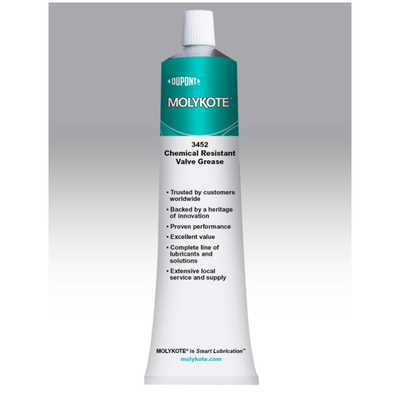
Main features
- Multi-Solvent Chemical Resistance
- Defined 8-Hour Exposure Testing
- 400 kg Four-Ball Weld Load
Product Description
MOLYKOTE® 3452 Chemical Resistant Valve Grease is a white, NLGI 2–3 fluorosilicone grease thickened with fluorinated polymer/PTFE for valves, seals, packings, and selected bearings exposed to chemically aggressive service. Its estimated service-temperature range is -31°C to 232°C, and typical data include 0.1% water washout, 1.0% bleed, 3.0% evaporation, and a 400 kg four-ball weld load under the stated test conditions. Documented applications include plug valves, rotary and reciprocating shaft seals, slow-speed roller and journal bearings, moderate-speed ball bearings, flexible ball joints, and instruments operating in high vacuum or corrosive atmospheres. Evaluate the actual chemical, elastomer, temperature, speed, and load conditions before specification.
Key features
- Chemical-resistant fluorosilicone system: Fluorosilicone oil with fluorinated polymer/PTFE thickener for chemically demanding valve, seal, and bearing applications.
- Wide estimated service range: -31°C to 232°C, with actual limits dependent on the application environment.
- Load-carrying test result: Typical ASTM D2596 four-ball weld load of 400 kg.
- Low washout and separation values: 0.1% water washout at 80°C for 1 hour and 1.0% bleed at 200°C for 24 hours.
- Conventional grease application: Apply by brushing, grease gun, or automatic applicator.
Applications / Suitable for
- Plug valves, mechanical seals, packings, and O-rings
- Rotary and reciprocating shaft seals
- Slow-speed roller and journal bearings
- Moderate-speed ball bearings and flexible ball joints
- High-vacuum instruments and equipment in corrosive atmospheres
Technical Specifications
No specifications available.
Additional Information
MOLYKOTE® 3452 Chemical Resistant Valve Grease
A white, NLGI 2–3 fluorosilicone grease for plug valves, seals, packings, and selected bearings exposed to aggressive chemicals, fuels, oils, solvents, high temperatures, or high vacuum. The PTFE-thickened formulation combines an estimated -31°C to 232°C service range with documented load, water-washout, bleed, evaporation, and chemical-exposure data.

MOLYKOTE® 3452 is supplied as a white fluorosilicone valve grease for chemical-resistant lubrication and sealing applications.
As-supplied grease properties
| Property | Value | Unit | Method / condition |
|---|---|---|---|
| NLGI consistency | 2–3 | — | As supplied |
| Worked penetration | 263 | 0.1 mm | ASTM D217; 60 strokes |
| Base-oil viscosity | 46,000 | SUS | Fluorosilicone oil at 100°F (38°C) |
| Specific gravity | 1.50 | — | At 77°F (25°C) |
| Product sizes | 550 g cartridge; 4.5 kg and 18 kg pails | — | Current supplier product-page availability; confirm regional stock |
Typical values are not specification limits. Base-oil viscosity, NLGI grade, worked penetration, and finished-grease application behavior are different selection parameters and should not be treated as interchangeable.
Service performance
| Property | Result | Unit | Method / condition |
|---|---|---|---|
| Service-temperature range | -31 to 232 | °C | Estimated; current supplier product-page range; application-dependent |
| Bleed | 1.0 | % | CTM 0033A; 24 h at 392°F (200°C) |
| Evaporation | 3.0 | % | 24 h at 392°F (200°C) |
| Dropping point | >570 (>300) | °F (°C) | Test transition; not a continuous operating limit |
| Water washout | 0.1 | % | ASTM D1264; 1 h at 175°F (80°C) |
| Four-ball weld load | 400 | kg | ASTM D2596 |
Typical laboratory results apply only to the stated methods and conditions. Dropping point, weld load, bleed, evaporation, water washout, and estimated temperature range describe different behaviors and must not be converted into universal service-life or equipment-capacity claims.
Apply with conventional grease-handling methods
Use brushing, a grease gun, or an automatic applicator according to the valve, seal, bearing, and maintenance procedure. Establish lubricant quantity, component cleanliness, compatibility, and replenishment practice on the actual assembly rather than inferring them from NLGI grade alone.
Shelf life is 60 months from the date of manufacture when stored at or below 90°F (32°C). Keep the product in properly labeled containers and review the current safety data and container label before handling. Elevated-temperature use or aerosol/spray exposure may require additional precautions.
Chemical resistance evidence
The following ratings are product-specific test results for a 1/16-in grease layer on an aluminum panel after 8 hours of chemical exposure and a subsequent 24-hour dry period at standard room temperature. They support chemical screening only and do not replace application-specific compatibility testing.
| Exposure medium | Rating | Rating interpretation |
|---|---|---|
| Diesel fuel | Excellent | No observable effect |
| Kerosene | Excellent | No observable effect |
| Silicone fluid | Excellent | No observable effect |
| Toluene | Good | Grease slightly soft; poor adhesion, with no effect on the grease itself |
| Hexane | Good | Grease slightly soft; poor adhesion, with no effect on the grease itself |
| Isopropanol | Excellent | No observable effect |
| Methanol | Excellent | No observable effect |
| VM&P naphtha | Good | Grease slightly soft; poor adhesion, with no effect on the grease itself |
| Xylene | Fair | Grease very soft, cracked, and with poor adhesion |
Valve, seal, and bearing applications
Applications span chemically exposed valve and sealing interfaces, selected low- to moderate-speed bearings, and instruments operating in high vacuum or corrosive atmospheres. Final selection should preserve the documented speed, load, temperature, chemical, and material boundaries.


Evaluate MOLYKOTE® 3452 for your valve, seal, or bearing system
Krayden can help review chemical medium and concentration, gasket or seal material, valve and bearing geometry, speed, load, temperature, vacuum conditions, application method, and compatibility with existing lubricants. Contact us to discuss product fit, sample requirements, or an application-specific evaluation plan.


